

 Food & Beverage Ingredients
 Timber & Engineered Wood
 Trade & Business Services
The global plant-based food industry experiences rapid expansion today. Industrial food processors continuously reformulate recipes to deliver authentic tastes. Modern retail consumers demand clean-label options across every retail shelf. Sourcing the right raw material remains an essential strategic priority. B2B buyers must evaluate ingredient profiles carefully before starting production runs.
Coconut milk and coconut water offer distinct functional capabilities for commercial food brands. Both agricultural products originate from mature or young coconuts. However, their nutritional profiles and physical characteristics differ significantly. Understanding these structural differences helps procurement directors make smart lumber and raw material purchasing decisions. Choosing certified coconut milk elevates finished product texture, preserves clean-label claims, and optimizes factory processing costs.
Technical Specifications and Nutritional Profiles
Commercial food developers choose specific raw material grades based on precise application needs. Fatty acid composition determines the functional role of each tropical ingredient during manufacturing.
Understanding Coconut Milk Functionality
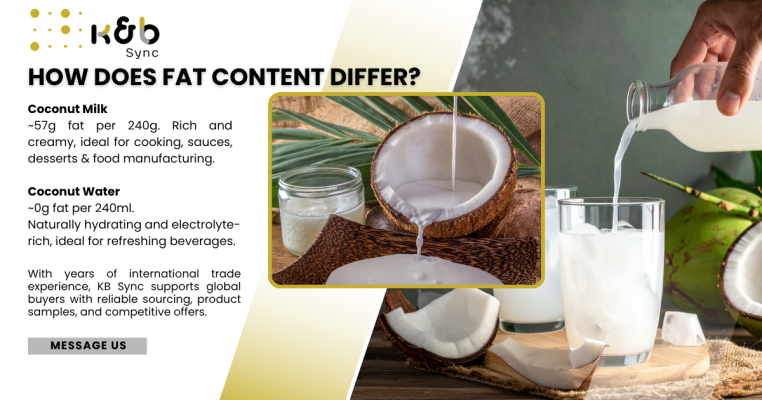
High-grade coconut milk delivers exceptional richness due to its natural lipid structure. Industrial processing units extract this liquid by pressing grated mature coconut meat with hot water. Standard commercial coconut milk contains substantial natural fat content. Formulators rely on high fat coconut milk to build luxurious mouthfeel without synthetic emulsifiers.
Modern processing facilities utilize mild thermal treatments during production. Gentle pasteurization protects delicate aromatic compounds within premium coconut milk. High quality coconut milk provides a smooth emulsion that remains stable under high baking temperatures. Food developers specify coconut milk to replace dairy cream across various commercial plant-based recipes.
Understanding Coconut Water Attributes
Fresh coconut water provides clear, low fat liquid with high natural electrolyte concentrations. It contains essential potassium, sodium, and naturally occurring sugars. Beverage formulators specify coconut water for rapid hydration sports drinks, RTD juices, and functional blends. Its isotonic composition matches human body fluids perfectly. Furthermore, low fat coconut water maintains high physical clarity without clouding finished formulations.
Detailed B2B Applications for Industrial Developers
Industrial buyers select coconut ingredients to satisfy specific structural goals inside commercial factories. Each liquid base serves distinct commercial product categories.
Commercial Uses for Coconut Milk
Formulators incorporate coconut milk into diverse plant-based food lines:
- Dairy-Free Confectionery: Premium coconut milk blends smoothly with cocoa solids. Chocolate plants use coconut milk to craft rich vegan chocolates and truffles.
- Cultured Dairy Alternatives: Fresh coconut milk supports beneficial probiotic fermentation. Dairy plants use coconut milk to ferment plant-based cheeses and yogurts.
- Gourmet Bakery Items: Commercial bakeries substitute liquid dairy with coconut milk. Rich coconut milk adds natural moisture to cakes, crusts, and muffins.
- Savory Sauces and Entrees: Industrial kitchens utilize coconut milk as a smooth base. Authentic coconut milk elevates commercial curries, soups, and ready-to-eat meal trays
Using organic coconut milk protects product identity while satisfying consumer demand for simple, recognizable ingredients.
Commercial Uses for Coconut Water
Beverage plants integrate coconut water into functional retail product categories:
- Pure Hydration Beverages: Bottlers package 100% pure coconut water for health-conscious shoppers.
- Hybrid Fruit Juices: Formulators blend coconut water with tropical purees to reduce overall calorie counts.
- Functional Lifestyle Drinks: R&D teams infuse coconut water with botanical extracts and natural vitamins.
Supply Chain Advantages of Vietnam Origin Sourcing
Establishing a resilient raw material supply chain remains a top strategic priority in global trade. Procurement directors build direct partnerships with verified wholesale suppliers to optimize factory production costs.
Selecting a Vietnam origin ingredient source guarantees access to superior agricultural raw materials. Vietnam origin palms thrive in the fertile Mekong Delta region. Local orchards yield coconuts with high natural fat levels and rich taste profiles.
Accredited Vietnamese manufacturing facilities enforce strict hygienic standards during processing. Automated extraction lines handle fresh coconut milk under aseptic conditions to prevent contamination. Modern suppliers maintain HACCP, ISO, and FDA certifications to simplify global trade compliance.
Experienced B2B suppliers export to Europe market shipping routes regularly to meet expanding European retail demand. Reliable exporters also handle ocean export to America market channels directly. Contracting bulk order volumes of coconut milk protects industrial brands against global market price volatility.
Secure Your Wholesale Supply with KB Sync
Upgrading your plant-based product lines with certified coconut milk protects operating margins and drives retail growth. Partnering with accredited wholesale suppliers guarantees continuous raw material availability for high-volume manufacturing.
We deliver export-grade coconut milk and natural coconut water with full technical support, competitive factory pricing, and guaranteed batch uniformity year-round. Contact our
